AI Marketing Tools 2026: The Complete Guide to the Tools Every Modern Marketer Must Use
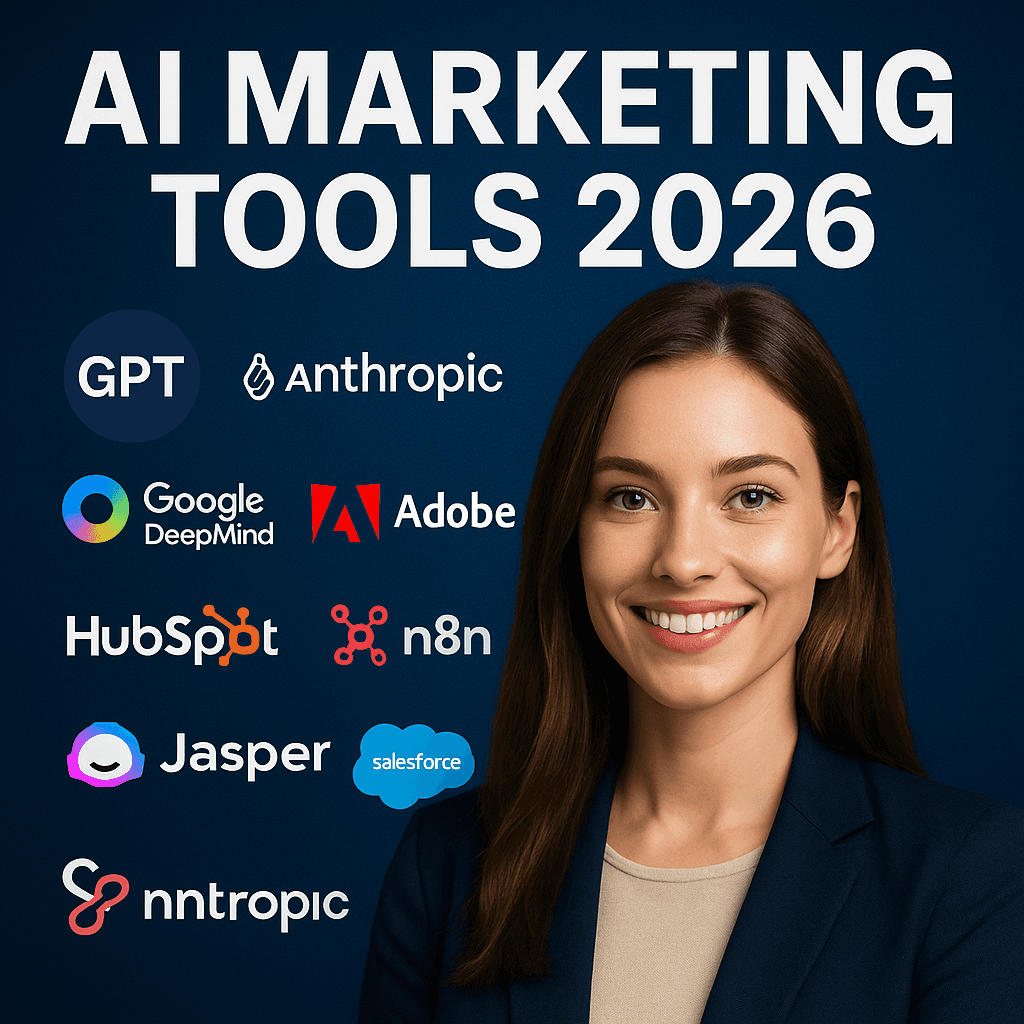
Table of Contents
- The 7 Archetypes of AI Marketing Tools
- Why this framework matters
- 1) Creator Tools — The Engines of Modern Content
- 2) Observer Tools — The Eyes of Your System
- 3) Predictor Tools — The Future Layer of Marketing
- 4) Connector Tools — The Nervous System of AI Marketing
- 5) Optimizer Tools — Where Performance Actually Improves
- 6) Identifier Tools — Where Brand Identity is Protected
- 7) Communicator Tools — Where Marketing Reaches the Customer
- Building the 2026 AI Marketing Stack + How to Choose the Right Tools
- How to Choose the Right Tools (The 5-Question Framework)
- Recommended AI Stacks for Different Business Sizes
- The Future: 2026–2030 — Where All of This Is Going
- SEO-Ready Conclusion (Emotional + Strong + Authority)
Marketing in 2026 is no longer a discipline defined by intuition, creativity, or even experience alone. It is defined by systems—systems powered by AI models, automated workflows, behavior-driven predictions, and intelligent content engines that work around the clock. We've entered an era where the AI Marketing Specialist who understands how to build and orchestrate these systems will outperform entire teams who still operate manually.
But let's pause for a second.
With hundreds of AI tools launching every year—each promising speed, optimization, or "revolution"—how do you choose the ones that actually matter? How do you know which AI marketing software deserves a place in your marketing stack and which ones will only waste your time?
More importantly:
How do you build a system that doesn't just look modern… but performs like the future?
That's the real challenge for marketers in 2026.
Not finding tools.
Choosing the right ones.
Because the truth is simple:
If you pick the wrong tools, your system becomes fragmented, slow, and expensive.
But if you pick the right ones, the entire marketing engine becomes:
- faster
- more accurate
- easier to scale
- and dramatically more profitable
This guide is written to help you make those choices with clarity, confidence, and strategy—not noise.
And it's not just another list of "50 AI tools you should try."
This is a system-based guide, built on a model that categorizes tools by the role they play in your marketing engine—not by the feature they advertise.
By the end of this guide, you'll understand exactly:
- which tools to use
- why they matter
- how they fit into your marketing architecture
- and how to build an AI Marketing Stack that can last through 2026 and beyond
So let's start with the framework that unlocks everything else.
The 7 Archetypes of AI Marketing Tools
A new system for understanding what actually matters
Instead of sorting AI tools for marketers by simple categories like "content," "analytics," or "automation," this guide uses a more accurate, practical, and modern approach. We classify tools by the strategic role they play in your marketing ecosystem.
Here are the 7 Archetypes:
1) Creator — Tools that produce content
This includes everything that generates text, images, videos, scripts, captions, ads, newsletters, or website copy.
Today's Creators are not just generators—they understand context, brand voice, market intent, and strategic goals.
Top examples include:
- GPT-4o / GPT-4.5 / o3 — long-form content, research, strategizing, multi-step reasoning
- Claude 3.5 — human-like writing, structured thinking
- Midjourney v7 — high-end conceptual and realistic imagery
- Adobe Firefly 3 — brand-consistent visuals
- Runway Gen-3 — AI video generation for ads, trailers, and UGC-style content
These aren't tools…
They're production studios compressed into algorithms.
2) Observer — Tools that reveal how users actually behave
This category includes the platforms that watch, measure, and highlight what's happening across your website, campaigns, funnels, and customer touchpoints.
Examples:
- Google Analytics 4 — behavior patterns, conversions, revenue paths
- Google Search Console — search intent, ranking insights, CTR dynamics
- Microsoft Clarity — heatmaps, session recordings, scroll behaviors
- Hotjar — qualitative UX and friction points
Without Observers, your marketing becomes guesswork.
With them, every decision becomes data-backed.
3) Predictor — Tools that forecast what will happen next
This is one of the most exciting transformations in marketing today. Predictors take historical data, model patterns, analyze behavioral signals, and generate insights about future outcomes.
Predictors help marketers understand:
- Which campaigns will perform best
- What content will gain traction
- What users are likely to do next
- Which customers are high-value
- What messaging drives conversions
The most advanced Predictor tools today include:
- Gemini 3 Ultra / Pro / Flash — For multi-modal reasoning, structured predictions, analytics, and ad optimization.
- OpenAI o3 — For agentic workflows, multi-step decision modeling, and predictive simulation.
- Claude 3.5 — Extremely strong in structured thinking, scenario modeling, and long-form analysis.
- Skywork AI — A rising analytics engine built natively for marketing teams.
- LTV.ai — Predictive personalization for retention, email, and lifecycle marketing—very likely to explode over the next 2–3 years.
These are the tools that turn marketing from reactive → to proactive.
4) Connector — Tools that link everything together
A modern marketing system fails without good connections.
It doesn't matter how powerful your tools are if they don't communicate.
Connector tools include:
- n8n — the future of AI-first automation: open-source, flexible, developer-friendly
- Zapier — the classic universal connector
- Make.com — workflow automation for complex systems
- Gumloop — a rising startup combining LLM automation with workflow orchestration
These tools ensure your content engine, analytics engine, CRM, and AI models all talk to each other.
5) Optimizer — Tools that improve performance automatically
What works in marketing rarely works forever.
Optimizers test, analyze, and refine key elements of campaigns.
Examples:
- Mutiny AI — personalizes landing pages at scale
- VWO / Optimizely — AI-driven A/B testing and experience optimization
Great optimizers save massive amounts of ad spend and increase ROI across channels.
6) Identifier — Tools that define brand identity
These tools help you shape and maintain visual consistency, messaging, and brand memory.
- Firefly for visual identity
- Midjourney for concept identity
- GPT-4o / Claude for tone-of-voice
- Looka or Canva AI for lightweight brand kits
Branding in 2026 isn't about design…
It's about consistency at scale.
7) Communicator — Tools that speak directly to your audience
This is where your marketing engine actually "touches" the customer.
Examples:
- Klaviyo AI — email/SMS personalization
- HubSpot AI — CRM + workflows + messaging
- Salesforce Einstein 1 — enterprise AI communication
This layer turns your strategy into real conversations.
Why this framework matters
Because choosing tools randomly leads to chaos.
But building a system around these 7 archetypes creates:
- clarity
- structure
- better decision-making
- easier scaling
- measurable ROI
This is how a modern marketing engine is built.
1) Creator Tools — The Engines of Modern Content
Content is no longer something you "make."
It's something you orchestrate.
And AI Creators are not simple "generators" anymore.
They are strategic partners that understand context, market positioning, tone-of-voice, brand consistency, and behavioral triggers.
But here's the real question you must ask yourself:
If an AI can generate content in seconds, what becomes your real job as a modern marketing specialist?
Pause for a moment.
Really consider it.
Your job becomes direction, quality control, strategy, and sequencing.
The AI writes—but you shape the system.
Sam Altman, CEO of OpenAI: "95% of what marketers use agencies, strategists, and creative professionals for today will easily, nearly instantly, and at almost no cost be handled by AI."
Source
Below are the Creators that dominate 2026.
🔵 GPT-4o / GPT-4.5 / o3 — The Thinking Engines
OpenAI's new generation models (GPT-4o, GPT-4.5, o3) are no longer just text generators.
They handle:
- long-form articles
- multi-step reasoning
- content research
- brand voice consistency
- cross-platform content adaptation
- data → narrative transformation
o3 in particular is becoming the backbone of:
- predictive content planning
- multi-step content workflows
- AI agents that generate → analyze → refine content
- automated SEO optimization systems
If you want one tool that can write, plan, analyze, and improve content in a loop, this is it.
🔵 Claude 3.5 — The Most Human Writer in AI
Claude 3.5 has a quality that marketers deeply value:
its writing feels human.
Emotionally aware, natural, smooth.
Claude is exceptional for:
- storytelling
- long-form blog posts
- brand messaging
- scripts
- metaphor-driven writing
- sensitive or narrative-heavy content
If GPT-4o is the architect, Claude 3.5 is the novelist.
Together, they form a complete writing engine.
🔵 Midjourney v7 — Realistic Vision at Scale
Midjourney remains irreplaceable for conceptual, cinematic visual storytelling.
In 2026:
- ad creatives
- hero images
- landing page visuals
- story-driven graphics
- brand conceptual imagery
are produced at a quality that rivals professional studios.
When your brand needs emotion in visuals, Midjourney delivers.
David Holz, Founder of Midjourney: "We see this technology as an engine for the imagination."
Source
🔵 Adobe Firefly 3 — Brand Consistency Comes First
Midjourney creates beauty.
Firefly creates brand identity.
Firefly is essential for:
- consistent brand colors
- typography control
- marketing banners
- website graphics
- ad design
- campaign-specific visual languages
If your brand relies on a fixed identity, Firefly protects it.
That's its job in your Creator suite.
🔵 Runway Gen-3 — AI Video Becomes the Default Format
Video isn't optional in 2026.
It's the new baseline.
Runway Gen-3 gives marketers the power to create:
- product videos
- UGC-style ads
- short-form content
- promo videos
- explainers
…all without a production team.
Runway is your AI video studio.
2) Observer Tools — The Eyes of Your System
Here is a truth most marketers ignore:
You cannot improve what you cannot see.
And yet many creators focus 90% of their time on production and less than 10% on observation.
That's why their results stagnate.
Your Observers tell you the truth—the raw, unfiltered reality of how your audience behaves.
Without them, you're operating blind.
🟠 Google Analytics 4 — Behavior in High Definition
Google Analytics 4 (GA4) is the backbone of understanding:
- user flow
- drop-off points
- conversion journeys
- attribution
- engagement
In 2026, GA4 is more powerful than ever because of tighter integration with:
- Gemini 3
- Google Ads
- Looker Studio
- AI-generated insights
GA4 is not a reporting tool.
It's a behavior lab.
🟠 Google Search Console — The Truth Behind Every Click
Google Search Console reveals:
- which keywords matter
- why your CTR rises or falls
- where your pages stand
- what people actually want when they search
If GA4 is the microscope,
Search Console is the telescope showing you the bigger landscape.
Every SEO decision you make should start here.
🟠 Microsoft Clarity — The Reality of User Experience
Microsoft Clarity gives you what numbers alone never can:
- heatmaps
- scroll-depth
- rage-clicks
- hesitations
- confusion points
- real user recordings
These insights help you answer critical questions like:
- Why do users hesitate on this page?
- Why do they scroll but not convert?
- Which elements distract them?
Clarity gives you clarity—literally.
🟠 Hotjar — Qualitative UX Intelligence
Hotjar remains the king of:
- UX feedback
- emotional reactions
- behavior interpretations
- friction mapping
If Clarity shows you what users do,
Hotjar helps you understand why they do it.
Both together give you a complete behavioral picture.
3) Predictor Tools — The Future Layer of Marketing
This is where marketing stops being reactive.
Where the system moves ahead of the customer.
Where you aren't guessing — you're forecasting.
The best predictive marketing tools transform marketing from:
"What happened?" →
"What will happen next?"
And the gap between these two questions is where profit lives.
🔵 Gemini 3 (Ultra / Pro / Flash) — Predictive Intelligence at Scale
Gemini 3 is Google's most advanced engine for:
- predictive analytics
- multi-modal reasoning
- ad performance forecasting
- audience modeling
- trend detection
Integrated with Google Ads + GA4, Gemini 3 is becoming the default engine for AI marketing professionals who want data-backed predictions instead of intuition.
If you run ads, Gemini 3 is no longer optional.
It's essential.
🔵 OpenAI o3 — The Multi-Step Reasoning Powerhouse
OpenAI o3 is not a content model — it's a thinking engine.
It's used for:
- multi-step marketing decisions
- predictive campaign simulations
- ROI estimation
- pattern detection
- customer behavior predictions
- agent-based marketing automation
Marketers who adopt o3 will outperform teams still stuck in manual analysis.
Dario Amodei, CEO of Anthropic: "I think we will be there in three to six months, where AI is writing 90% of the code."
Source
🔵 Claude 3.5 — Structured, Deep, Strategic Prediction
Claude is brilliant at:
- scenario modeling
- multi-branch planning
- structured forecasts
- interpreting complex datasets
While GPT-4o dominates in creativity,
Claude dominates in clarity and structured thinking.
For predictive strategy, it's unmatched.
🔵 LTV.ai — The Email/SMS Prediction Engine (Rising Startup)
LTV.ai is one of the most exciting emerging tools:
- predicts customer value
- forecasts churn
- personalizes messages
- optimizes email/SMS flows
Brands like Fabletics already use it — and it's growing fast.
This might become one of the next major players in AI CRM.
🔵 Skywork AI — LLM-Native Analytics for Marketers
Skywork AI is built for:
- predictive dashboards
- trend modeling
- content performance forecasting
- multi-channel analysis
It's one of the few startups creating a true AI analytics layer from scratch.
A very strong bet for the future.
4) Connector Tools — The Nervous System of AI Marketing
You can have GPT-4o writing your blogs, Gemini 3 analyzing your conversions, Claude 3.5 modeling future scenarios…
But if these systems cannot communicate, you're left with isolated islands of intelligence instead of a unified marketing engine.
Connector tools solve that.
They act as the nervous system, the wiring that links everything together.
And not all connectors are created equal.
🟣 n8n — The AI-First Automation Layer Every Modern Marketer Needs
If one automation tool represents the future, it's n8n.
Unlike other marketing automation tools built for no-code simplicity, n8n is built for:
- flexibility
- power
- scalability
- AI-native workflows
- multi-step logic
- integrations with LLMs
- API-heavy systems
It is open-source, self-hostable, developer-friendly, and capable of building:
- AI research agents
- automated content pipelines
- lead scoring systems
- predictive workflows
- multi-agent marketing automations
- internal dashboards
- integrated CRM flows
If Zapier is a "bridge,"
n8n is a highway system.
For any marketer building a custom AI ecosystem (like you someday with Contlyze or Selphlyze), n8n is essential.
Jan Oberhauser, Founder/CEO of n8n: "You cannot just jump on everything. If your product is not well set up for it, you'll build a solution that's not helpful for anybody."
Source
🟣 Zapier — Still the Gateway Tool
Zapier remains the most popular connector because:
- it's simple
- it has the largest app library
- it's reliable
- anyone can use it
While it's not as flexible as n8n, it excels at fast automation:
- connecting CRM to forms
- linking AI tools to databases
- syncing email triggers
- automating repetitive tasks
In 2026, Zapier isn't the most powerful automation tool—not even close.
But it remains the easiest entry point.
Think of it as the "plug & play" option.
🟣 Make.com — For Visual, Complex Workflows
Make.com (formerly Integromat) appeals to marketers who want:
- multi-step workflows
- advanced logic
- visual automation architecture
- branching scenarios
It's perfect for visual thinkers or teams that manage complex multi-channel marketing.
If n8n is the engine,
Make is the dashboard.
🟣 Gumloop — The Startup That Might Become the Next Big Automation Platform
Gumloop is one of the most underrated AI automation startups right now.
It combines:
- LLM orchestration
- automation flows
- research agents
- scraping tools
- data workflows
- content routing
It's newer, younger, faster—and exactly the type of startup that can blow up in 2027 or 2028.
If you're building an AI-first marketing stack, Gumloop earns a place in your toolkit.
5) Optimizer Tools — Where Performance Actually Improves
This is the category most marketers ignore.
And it's also the category that often generates the biggest revenue growth.
Creators help you produce content.
Observers tell you what's happening.
Predictors tell you what's next.
Connectors keep things flowing.
But Optimizers?
They turn performance into profit.
These tools find every friction point, every leak, every wasted moment—and fix them.
Let's look at the tools shaping optimization in 2026.
🟩 Mutiny AI — The King of Landing Page Personalization
Mutiny AI is one of the most powerful CRO tools on the market because it:
- personalizes landing pages
- adapts messaging based on segment
- suggests new copy
- tests page versions
- identifies friction points
And it does all of it with AI-driven insights.
Imagine a visitor lands on your page.
Mutiny changes:
- the headline
- the call-to-action
- the benefits
- the images
- the tone of voice
…based on their industry, behavior, or acquisition source.
This is personalization at scale — and it works.
🟩 VWO — AI-Enhanced A/B Testing
VWO built its reputation on testing, but now:
- AI recommends variant ideas
- AI predicts winning versions
- AI analyzes behavior trends
It's perfect for optimizing conversions on:
- homepages
- pricing pages
- landing pages
- signup flows
If you care about squeezing more ROI out of your traffic, VWO is essential.
🟩 Optimizely — Enterprise-Grade Optimization
Optimizely remains the gold standard for larger brands.
It excels in:
- experimentation
- content delivery
- personalization
- digital experience orchestration
In 2026, Optimizely is increasingly powered by:
- AI-driven segmentation
- predictive insights
- automated test decisions
If Mutiny is the sniper,
Optimizely is the artillery.
6) Identifier Tools — Where Brand Identity is Protected
AI can generate infinite content, but consistency is the real challenge.
Brand identity is the glue that holds perception together.
Identifier tools ensure:
- visual consistency
- tone consistency
- messaging consistency
- emotional consistency
These tools do not get the spotlight, but they are absolutely essential.
🟦 Adobe Firefly — Identity-First Visual Creation
Firefly protects brand integrity through:
- color preservation
- typography alignment
- design rules
- consistent image style
It ensures your brand's visual DNA stays intact, even when producing content at scale.
🟦 Midjourney — Concept Identity & Emotional Design
Midjourney isn't just a Creator tool — it's an identity shaper.
It helps define:
- brand mood
- brand persona
- campaign vibes
- internal creative directions
When you need differentiation in visual storytelling, Midjourney delivers.
🟦 GPT-4o / Claude — Voice & Message Consistency
AI text generators have become the brand's voice engines.
They protect:
- tone
- language
- emotional structure
- rhythm of communication
Without them, your brand message becomes fragmented.
7) Communicator Tools — Where Marketing Reaches the Customer
This is where all your strategy becomes reality.
Communicator tools represent:
- SMS
- CRM
- customer nurturing
- lifecycle management
They turn the system into a conversation.
🟪 Klaviyo AI — Personalized Email & SMS at Scale
Klaviyo AI has exploded thanks to:
- AI segmentation
- predictive send-times
- behavior-based flows
- personalized messaging
It is the best choice for eCommerce and lifestyle brands.
🟪 HubSpot AI — A Full AI CRM for Modern Teams
HubSpot AI continues to dominate because it integrates:
- CRM
- landing pages
- automation
- analytics
- AI workflows
If you want an all-in-one approach, HubSpot AI is unmatched.
🟪 Salesforce Einstein 1 — Enterprise AI Communication
Salesforce Einstein 1 offers:
- predictive communication
- AI-based lead scoring
- automated sales messaging
- behavioral segmentation
Perfect for enterprise environments.
Building the 2026 AI Marketing Stack + How to Choose the Right Tools
Now that we have explored all seven archetypes—Creator, Observer, Predictor, Connector, Optimizer, Identifier, and Communicator—it's time to put them together into a single cohesive system.
This part is where everything becomes practical.
Because here's the truth most marketers never realize:
Your AI tools don't matter nearly as much as the system you build with them.
Tools alone will not create growth.
Tools without structure will create noise, complexity, and wasted time.
But tools that are strategically combined will create AI-powered marketing systems that feel like magic — fast, intelligent, and constantly improving themselves.
So let's design that system.
Nima's AI Marketing Stack 2026 (Signature Edition)
A complete, professional, battle-tested architecture.
This is not a random list.
This is a full operating system for modern marketing, built around the 7 archetypes and optimized for performance, automation, and prediction.
🔵 1. Creation Layer — Content Engine
Use a combination of:
- GPT-4o / 4.5 / o3 → long-form, research, strategic writing
- Claude 3.5 → human-like storytelling, emotionally natural writing
- Midjourney v7 → conceptual visuals, campaign direction
- Firefly 3 → brand-consistent visuals for website & ads
- Runway Gen-3 → video creation for ads, short-form, promos
Goal: Create a high-volume, high-quality content engine that feeds every channel.
🟠 2. Observation Layer — Behavior Intelligence
Use:
- GA4 → user journeys + conversion paths
- Search Console → keyword performance + CTR dynamics
- Clarity → UX heatmaps + session behavior
- Hotjar → qualitative insight + friction mapping
Goal: See how your audience behaves in detail.
🔵 3. Prediction Layer — Strategy & Forecasting
Use:
- Gemini 3 Ultra / Pro / Flash → predictive analytics + ad forecasting
- o3 → multi-step reasoning + predictive simulations
- Claude 3.5 → scenario modeling + structured prediction
- LTV.ai → churn prediction + retention modeling
- Skywork AI → LLM-native analytics
Goal: Make proactive decisions, not reactive ones.
🟣 4. Connection Layer — Workflow Automation
Use:
- n8n → AI-first, flexible, scalable workflows
- Zapier → simple universal connectors
- Make.com → visual logic and complex branching
- Gumloop → AI-native automation + research agents
Goal: Build a unified marketing machine that never stops running.
🟩 5. Optimization Layer — Conversion & Experience
Use:
- Mutiny AI → landing page personalization
- VWO → AI A/B testing
- Optimizely → enterprise experimentation
Goal: Increase ROI without increasing traffic.
🟦 6. Identity Layer — Brand Consistency
Use:
- Firefly → identity-based visual assets
- Midjourney → conceptual art, brand vibes
- GPT-4o / Claude → tone-of-voice consistency
Goal: Ensure your brand feels unified everywhere.
🟪 7. Communication Layer — Customer Engagement
Use:
- Klaviyo AI → email + SMS personalization
- HubSpot AI → CRM + workflows + messaging
- Salesforce Einstein 1 → enterprise-level communication
Goal: Deliver the right message, at the right time, to the right segment.
How to Choose the Right Tools (The 5-Question Framework)
Before you add anything to your stack, ask these 5 questions:
1. Does this tool replace a manual process or create a new capability?
If it doesn't save time or unlock something new, it's noise.
2. Does it fit into one of the 7 archetypes?
If not, it probably won't integrate well.
3. Can it work with the tools I already use?
The strongest tool is useless if it doesn't connect.
4. Will this still matter in 2–3 years?
Big warning sign: tools built only around "trending features."
5. Does it reduce complexity rather than add to it?
The best AI systems feel simpler, not more complicated.
Recommended AI Stacks for Different Business Sizes
Not every business needs everything.
Here are three perfectly balanced setups.
🔹 For Startups (Lean, Fast, Low Cost)
- GPT-4o for content
- Midjourney for visuals
- GA4 + Search Console for analytics
- n8n for automation
- Mutiny AI for landing pages
- Klaviyo AI for communication
Why this works:
Maximum impact with minimal tools.
🔹 For Small to Medium Businesses (Scalable & Predictive)
- GPT-4o + Claude for content
- Firefly + Runway for brand and video
- GA4 + Clarity + Hotjar for behavior
- Gemini 3 + o3 for prediction
- n8n + Make.com for automation
- Mutiny + VWO for CRO
- HubSpot AI for CRM
Why this works:
Balanced—strong automation, strong prediction.
🔹 For Enterprise (Full AI Operating System)
- GPT-4o / Claude 3.5 / Gemini 3 Ultra
- Midjourney + Firefly + Runway
- GA4 + Looker Studio + advanced Clarity setups
- Custom predictive models (o3 + Vertex AI)
- n8n + Salesforce + HubSpot AI hybrid
- Optimizely Enterprise
- Salesforce Einstein 1
Why this works:
Maximum stability, maximum intelligence, maximum personalization.
The Future: 2026–2030 — Where All of This Is Going
If today's AI tools feel powerful, the next four years will feel unbelievable.
Here's what's coming:
- Marketing agents that plan and execute campaigns autonomously
You'll give a goal → the system will build, launch, test, optimize. - Real-time predictive personalization
Every page, every email, every ad customized instantly. - Multi-agent collaboration
GPT + Claude + Gemini working together as specialized roles. - Behavior-driven brand identity systems
AI will adjust brand voice based on audience response. - Marketing without dashboards
Your AI will summarize everything you need to know each morning. - Full automation of routine marketing tasks
Copywriting → scheduled
Analytics → automated
Optimization → continuous
Personalization → real-time
The marketers who win are the ones who start building systems now.
SEO-Ready Conclusion (Emotional + Strong + Authority)
AI marketing tools are not just software.
They are the infrastructure of the next digital era.
In 2026, the marketers who understand how to combine these tools into a single intelligent system will be the ones who:
- scale faster
- spend less
- predict better
- create more
- and understand their customers at a level competitors cannot match
This guide showed you the 7 archetypes, the tools that define each one, and the exact structure you need to build your 2026 AI Marketing Stack. For more insights on modern marketing strategies, explore our collection of marketing articles.
The future of marketing is not human vs. AI.
It is humans who know how to use AI vs. those who don't.
And the ones who understand the system…
are the ones who win.
Daniela Amodei, Co-founder & President of Anthropic: "The first ultraintelligent machine is the last invention that man need ever make."
Source
Ready to build your AI Marketing Stack?
This complete guide covers all 7 archetypes of AI marketing tools: Creator, Observer, Predictor, Connector, Optimizer, Identifier, and Communicator. You now have a comprehensive framework for building a modern AI marketing stack that performs like the future.
To explore these tools even deeper and gain a clearer understanding of how modern marketing is evolving, you can continue learning about advanced AI marketing strategies, the role of an AI Marketing Specialist, and the structure of a complete AI marketing stack.
Discover the future of AI-powered content creation, predictive marketing, AI automation workflows, and digital marketing tools that shape growth in 2026.
Whether your focus is on improving conversions, building better customer journeys, or scaling your content engine with the help of AI, mastering these next-generation tools is the foundation for becoming a truly modern marketing professional.