What Does an AI Marketing Specialist Do? (2025 Complete Guide)
TL;DR — Quick Summary
An AI marketing specialist designs AI-powered, data-driven systems that predict customer behavior, generate and test content, and automate decisions across the entire funnel. In this 2025 guide, you'll see what the role looks like day to day, which skills and tools you need, and a clear roadmap to become an AI marketing specialist—even if you don't have a technical background.
In 2025, McKinsey research on AI and behavioral insights shows that AI marketing is far more than tools—it is a behavior-first methodology that turns data, psychology, and prediction into a measurable operating system. Understanding what does an AI marketing specialist do has become essential for businesses navigating this new landscape. This article breaks that transition into four actionable sections so you can map where your team is today and what it takes to lead in the modern AI marketing environment.
What Does an AI Marketing Specialist Do? (Short Answer)
An AI Marketing Specialist uses artificial intelligence, data, and consumer psychology to plan, execute, and optimize marketing systems. Their job is to turn user behavior, content, and automation into predictable growth and measurable business outcomes.
Key responsibilities include:
- Analyzing customer behavior and marketing data to identify patterns
- Using AI tools to create, test, and optimize content and campaigns
- Building audience segmentation and scoring models
- Designing customer journeys that reduce friction and increase conversions
- Connecting AI insights to real marketing actions
- Reporting clear, business-focused results such as leads, revenue, CAC, and LTV
1. The New Foundation of AI Marketing 2025: Behavior, Data, and Human Decision-Making
In 2025, marketing has entered a stage where traditional frameworks can no longer keep up.
Data volumes have multiplied, consumer behavior has become more complex, and algorithms detect patterns long before humans notice them.
In this environment, the role of an AI Marketing Specialist has shifted from a futuristic luxury to a fundamental requirement for any brand that wants to remain competitive. The AI marketing role has evolved beyond traditional marketing functions, requiring deep integration of behavioral psychology, data science, and predictive analytics.
Today, successful brands are not those that simply "produce more content," but those that understand how to interpret human behavior, translate patterns hidden in data, and align their messaging with the emotional and cognitive states of their audience. This is where the AI marketing specialist becomes indispensable, bridging the gap between data and human psychology.
This shift requires a fundamental change in how marketing operates—moving from content volume to behavioral intelligence.
This is the core of modern AI Marketing:
AI doesn’t make marketing faster—AI makes marketing deeper.
Marketing is no longer about delivering messages. It is about understanding:
- why people respond the way they do
- what motivates a decision
- what creates trust
- what internal barriers stop a user from taking action
I realized this shift not in theory, but through practical experience working across multiple industries.
Brands weren't failing because they lacked content or design. They were failing because they didn't understand the psychological and behavioral drivers behind their audience's decisions.
This is exactly where AI changes everything.
Whether you call it an AI Marketing Specialist, this role is not about using tools on top of traditional marketing. The AI marketing specialist operates at a fundamentally different level, orchestrating systems that learn and adapt.
It is about redesigning how marketing thinks about behavior, data, and human decision-making at scale. Understanding what does an AI marketing specialist do requires recognizing that this is a strategic role, not just a technical one. To learn more about AI marketing articles and strategies, explore our comprehensive content library.
Why AI Marketing and AI Consumer Behavior Work at a Psychological Level
When you analyze real purchase behavior through consumer behavior analysis, it becomes clear that people do not make decisions based solely on information or logic. This is where behavioral marketing and consumer behavior analysis intersect with AI marketing strategies. Instead, decisions arise from a blend of:
- emotion
- trust
- perceived risk
- subconscious associations
- internal needs and anxieties
Harvard decision-making research has long shown that a significant majority of human decisions occur at a subconscious level. This means that marketing strategies focused purely on rational messaging are inherently limited. This aligns with behavioral psychology in marketing and AI research on behavioral patterns and consumer psychology.
AI enables marketers to interpret the hidden layers beneath human decisions by analyzing:
- emotional language in comments and messages
- hesitations and uncertainties in search patterns
- the frequency and tone of specific concerns
- the user’s emotional reaction to different content styles
- the cognitive framing that influences attention and trust
For example, when NLP models analyze customer messages, they often reveal unexpected behavioral patterns:
- customers are not confused about the process — they are uncertain about the risk
- they are not asking about the service — they are asking about trust
- they are not comparing features — they are comparing security
These insights rarely emerge through manual analysis. But AI reveals them within minutes, allowing marketing teams to design strategies that connect directly with emotional and cognitive triggers.
A true AI Marketing Specialist functions almost like a data-driven psychologist—someone who understands not just what people say, but what they mean beneath the surface.
Where AI Marketing Systems Become a Strategic Advantage
Across different businesses, industries, and audience groups, I noticed a consistent pattern: AI reveals insights that humans overlook, and those insights radically improve performance. AI marketing systems transform how brands understand and engage with their audiences. This is the power of data-driven marketing combined with AI-driven insights—creating a competitive advantage that traditional approaches cannot match.
Below are the most impactful examples. You can see detailed Case studies from implementing these strategies.
- The gap between what brands say and what audiences actually hear. AI shows that audiences care about trust, risk, and whether the solution will work for someone like them.
- Predicting behavior before it happens. AI predicts topics, formats, tone, timing, and potential failures before content goes live, preventing wasted effort.
- Identifying emotional patterns humans overlook. AI detects subtle signatures—cold educational posts, anxiety-triggering narratives, or trust-building structures.
- Turning marketing into an integrated system rather than isolated actions. AI merges search behavior, navigation, engagement, content style, funnel drop-offs, and emotional responses into a behavioral model.
Small insights often create massive outcomes. When AI flagged a single line of text as a conversion drop, rewriting it tripled the result. This is why AI marketing is not about tools—it is about understanding human behavior at a depth traditional marketing cannot reach.
Instead of guessing:
- what people want
- how they decide
- why they hesitate
- what emotional triggers matter
- what message increases trust
- what content builds credibility
- what pattern leads to conversion
AI makes these invisible factors measurable and predictable. This is why modern marketing is shifting toward:
- psychology-driven content
- data-backed decision-making
- emotional intelligence modeling
- predictive marketing strategy
- dynamic optimization
- user-behavior–aligned branding
This foundation prepares us for the next section, where we define the exact responsibilities and skill sets of an AI Marketing Specialist—and how this translates into real business results.
Key Takeaways
- • AI Marketing Specialist is now a fundamental requirement, not a luxury
- • AI marketing focuses on understanding human behavior at a psychological level, not just producing content
- • Most decisions occur subconsciously, requiring behavior-driven marketing approaches
- • AI reveals insights that humans overlook, creating strategic advantages
- • The shift is from reactive marketing to predictive marketing systems
What Does an AI Marketing Specialist Do Day to Day?
On a typical day, an AI Marketing Specialist may:
- Review dashboards from analytics, CRM, or ad platforms
- Analyze user behavior signals such as clicks, scrolls, drop-offs, and conversions
- Use AI tools to summarize data and identify insights
- Create and refine prompts for content, ads, and landing pages
- Run A/B tests on headlines, CTAs, emails, or creatives
- Update audience segments and automation workflows
- Collaborate with designers, copywriters, and engineers
- Translate data into clear recommendations for decision-makers
Key Skills of an AI Marketing Specialist
An effective AI Marketing Specialist combines technical awareness with marketing and psychology skills. Understanding AI marketing specialist skills is essential for anyone entering this field:
- Consumer behavior and behavioral psychology
- Data literacy (funnels, analytics, performance metrics)
- AI tools and prompt engineering
- Marketing automation and workflows
- Copywriting and content strategy
- Experimentation and A/B testing
- Business metrics such as CAC, LTV, and conversion rates
For a deeper dive into developing these competencies, see our comprehensive guide on AI marketing skills 2025.
How to Become an AI Marketing Specialist
You do not need to become a data scientist to enter this role. Understanding what an AI marketing specialist does is the first step. A practical path to becoming an AI marketing specialist looks like this:
- Learn core digital marketing fundamentals (SEO, content, email, paid media)
- Master a small set of AI tools used in marketing
- Study consumer psychology and decision-making
- Build a simple AI-driven marketing project or system
- Document your work as case studies or a portfolio
- Apply for roles or clients where you own part of the AI marketing workflow
2. What an AI Marketing Specialist Really Does — Skills, Layers, and Real Business Impact
After establishing why AI-driven marketing has become essential, the next logical question is clear:
What does an AI Marketing Specialist actually do—and why is this role so different from traditional marketing?
In practical terms, an AI marketing specialist is the person responsible for translating complex behavioral and data signals into a marketing system that is precise, predictable, and psychologically aligned with the audience. The AI marketing specialist role encompasses everything from consumer behavior analysis to predictive marketing strategy. Working with an AI Marketing Specialist brings this level of strategic depth to your business. To understand the full scope of what an AI marketing specialist does, this guide covers daily responsibilities, required skills, and career pathways.
Contrary to what many assume, an AI Marketing Specialist is not simply someone who uses AI tools.
The role is built on three interconnected dimensions:
- Understanding human behavior at scale
- Translating data into actionable insights
- Building predictive, scalable marketing systems
These dimensions allow brands to move from reactive marketing to proactive, behavior-driven decision-making. Below, we break down each dimension in detail.
1. Cognitive & Emotional Layer: How an AI Marketing Specialist Understands AI Consumer Psychology
The foundation of AI Marketing begins with a deep understanding of how people think, feel, and make decisions.
A real specialist goes beyond demographics and focuses on subconscious motivations, emotional triggers, perceived risks, trust formation, cognitive biases, and decision-making patterns.
AI models make this possible by analyzing sentiment in messages, emotional tone in comments, hesitation patterns in search queries, words associated with fear, risk, trust, or excitement, and the emotional reaction to different content styles.
For example, when analyzing thousands of user messages in a service-based business, AI frequently identifies patterns like:
- Users aren’t worried about the “details”—they’re worried about the “outcome.”
- They’re not asking about “features”—they’re seeking “certainty.”
- They don’t need “more information”—they need “more confidence.”
This level of clarity is what allows an AI Marketing Specialist to create messaging that aligns with how people actually decide.
Traditional marketers focus on "what to say." AI marketers focus on why the audience responds.
2. Analytical Layer: Data-Driven Marketing and Predictive Marketing Insights
Once emotional and cognitive patterns are identified, the next layer involves transforming raw data into meaningful insights.
This part of the role includes:
- analyzing search behavior
- identifying hidden user intent
- mapping user flows on websites
- discovering drop-off points
- evaluating content performance
- benchmarking competitors
- clustering topics based on behavioral patterns
- segmenting audiences psychologically rather than demographically
AI plays a crucial role in this layer. It helps answer questions such as:
- Why do users leave at a specific point of the journey?
- Which content has the highest emotional engagement?
- What topics are emerging before competitors notice them?
- Which keywords reflect unconscious motivations, not just explicit queries?
A simple example: In many case studies, AI has revealed that users do not engage with content because of the topic, but because of the emotional tone. Users might prefer confident over explanatory, clear over creative, structured over inspirational, concise over dramatic. This aligns with HubSpot research on content engagement patterns, which consistently shows that emotional alignment outperforms informational density.
Without AI, identifying such subtle psychological preferences is nearly impossible. But once identified, these preferences transform the entire strategy.
3. Strategic Layer: How an AI Marketing Specialist Designs AI Marketing Systems
After understanding human behavior and analyzing data patterns, an AI Marketing Specialist moves into the strategic role: designing a complete, predictable AI marketing system. This system integrates seamlessly with behavioral insights and predictive analytics to deliver measurable results.
A well-designed system should be behavior-driven, data-informed, emotionally aligned, scalable, and adaptable.
This part of the job includes:
- defining the brand's verbal identity
- aligning content with emotional triggers
- structuring topics around user intent
- setting publishing rhythms based on behavioral data
- designing user journeys that minimize friction
- writing content with psychological precision
- integrating SEO into behavioral insights
Effective AI content creation and content architecture expertise is central to this process. The AI marketing specialist leverages generative AI marketing tools and AI content creation systems to scale production while maintaining psychological alignment with the audience.
For example: If data shows that the audience values clarity, then:
- content must be direct
- sentences must be short
- uncertainties must be removed
- proofs and examples must be central
- calls-to-action must be explicit
If the audience cares more about reducing risk: highlight guarantees, show clear before/after outcomes, provide transparent process explanations, and include social proof with emotional cues.
If trust is the core concern: expert positioning becomes key, tone shifts from marketing to consulting, educational micro-content performs better, and messaging becomes more authoritative. This is where an AI Branding Specialist adds strategic value.
These are not creative decisions—they’re behavioral decisions guided by AI insights.
4. Behavioral Marketing Content Layer: Content That Adapts to Human Psychology
Content in AI Marketing is fundamentally different from traditional content. It is:
- informed by emotional patterns
- designed according to user behavior
- optimized before it is published
- aligned with the audience's mental model
- updated continuously based on new data
This layer explains why two pieces of content with the same information can perform completely differently. The difference is not the words—it is the psychological fit.
Consider a scenario: Users interact well with long-form posts, but only if the opening creates immediate mental clarity. Once the introduction shifts from vague to structured, retention times often increase dramatically.
Or a case where AI identifies that users respond better to high-light, low-shadow imagery, warmer tone captions, bullet-based explanations, and clear functional promises instead of emotional storytelling. These small adjustments—driven by data rather than intuition—often produce significant improvements in performance metrics.
This is the difference between content that is “good” and content that is psychologically effective.
5. Optimization Layer: Data-Driven Marketing and Continuous Improvement
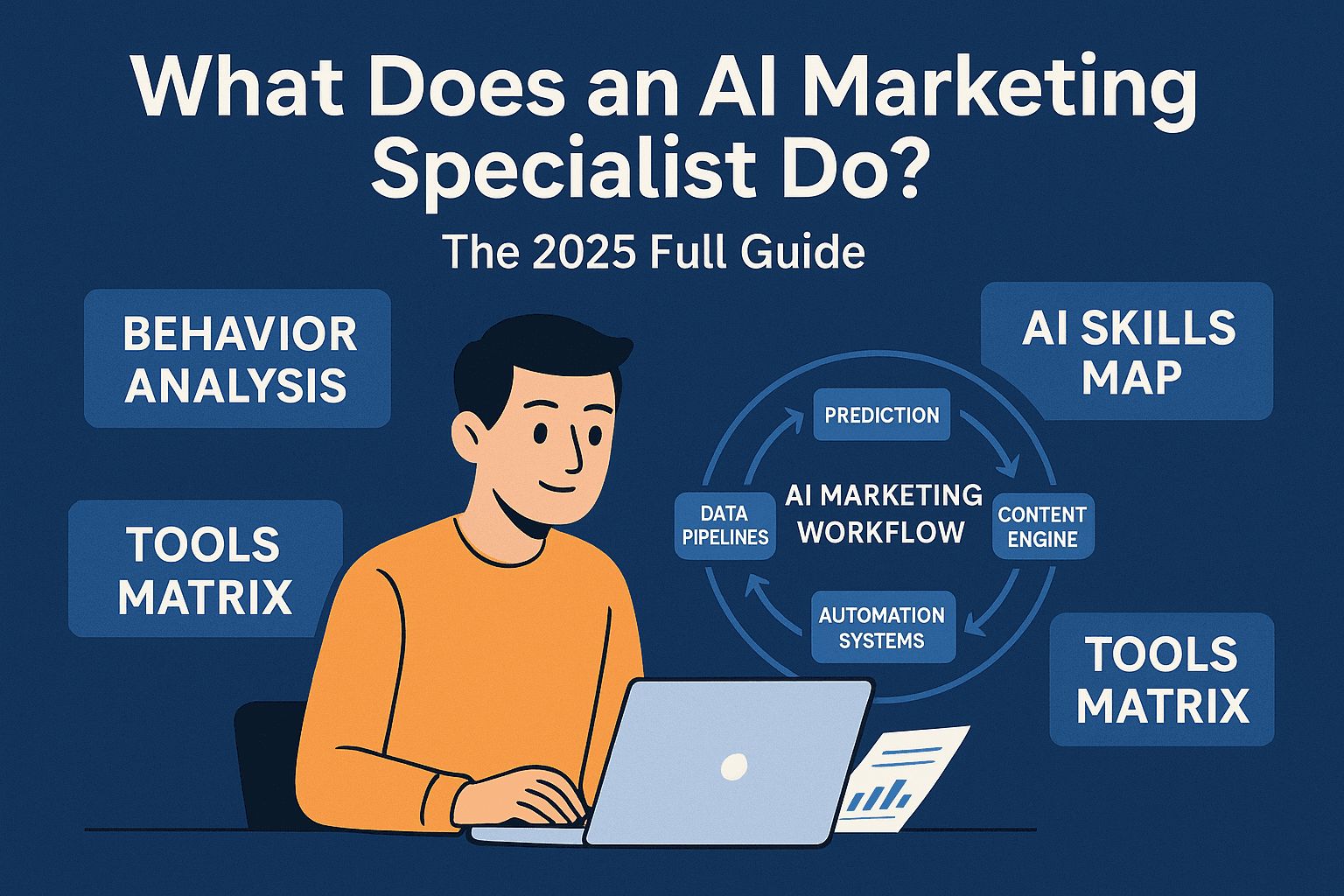
AI Marketing is never static. It runs through a constant loop: Data → Analysis → Prediction → Content → Audience Response → New Data. This continuous cycle is what makes the AI marketing role so dynamic and powerful.
This optimization cycle enhances click-through rate (CTR), user retention, time-on-page, scroll depth, conversion rate, lead quality, and overall brand trust. Through marketing automation and AI-driven insights, the AI marketing specialist can scale these improvements across all channels. According to Statista market research, companies using AI-driven optimization see 30-40% improvements in key marketing metrics compared to traditional approaches.
Traditional marketing optimizes after the fact. An AI Marketing Specialist optimizes in real time, adjusting based on live behavior signals.
For example: If users hesitate at a specific sentence, content is rewritten. If search queries shift, the content structure is adapted. If emotional tone changes, messaging is recalibrated. If competitor behavior changes, response strategies evolve.
This dynamic, adaptive structure is what allows AI-driven marketing to outperform static traditional strategies.
Real Examples: How an AI Marketing Specialist Improves Performance
Across various industries, AI-driven marketing produces consistent improvements. See detailed case studies and real results from implementing these strategies:
- ✔ Higher clarity — Messaging aligned with psychological needs.
- ✔ Better trust formation — Content feels rational, structured, and confidence-building.
- ✔ Stronger conversions — Behaviorally aligned content leads to faster decisions.
- ✔ Reduced wasted effort — No more content the audience doesn’t care about.
- ✔ Predictability — Marketing becomes measurable instead of guesswork.
These improvements are the practical outcome of understanding behavior, analyzing patterns, and applying strategic psychological insights—supported by AI.
This role represents a new category of strategic thinking—one that blends behavioral psychology, data science, linguistic intelligence, content engineering, strategic prediction, and system design.
This combination allows brands to understand people more accurately, respond faster, and grow with far more precision.
These principles turn into a complete, actionable framework that delivers strategic depth for brands ready to transform their marketing.
Key Takeaways
- • An AI Marketing Specialist operates across three dimensions: cognitive/emotional, analytical, and strategic
- • Behavior-driven marketing requires understanding subconscious motivations, not just demographics
- • Content must align with psychological preferences—often clarity over creativity, certainty over features
- • Real-time optimization based on behavior signals outperforms static traditional strategies
- • The role blends behavioral psychology, data science, and strategic system design
AI Marketing Skills Map (2025)
The role of an AI Marketing Specialist requires a unique blend of skills that combine psychology, data analysis, and strategic thinking. When considering what does an AI marketing specialist do, understanding these AI marketing skills 2025 becomes essential. Below is a comprehensive map of the core skills needed:
| Skill Category | Specific Skill | What It Actually Means | Impact on AI Marketing | Learning Priority (1–5) |
|---|---|---|---|---|
| Behavioral Psychology | Understanding Emotional Triggers | Reading patterns in decision-making, identifying subconscious motivations, and mapping emotional responses to content and campaigns | Improves campaign targeting accuracy and reduces wasted ad spend by aligning with actual user psychology | 5 |
| Data Literacy | Reading Analytics & Funnels | Interpreting GA4, funnel drop-offs, cohort analysis, and basic statistical patterns in marketing data | Enables data-driven decision-making instead of guessing what works | 5 |
| Prompt Engineering | Designing Structured Prompts | Creating precise, structured prompts for LLMs that generate high-quality, on-brand content at scale | Scales content production while maintaining brand voice and reducing manual creation time | 4 |
| AI Model Awareness | Selecting Right Models | Knowing when to use LLMs for text, vision models for creatives, predictive models for forecasting, and classification models for segmentation | Ensures optimal performance by matching the right AI tool to each marketing task | 4 |
| Automation Design | Building Workflows | Designing automated workflows with tools like Zapier, n8n, or custom integrations that connect AI outputs to marketing actions | Reduces manual work and enables 24/7 marketing systems that adapt in real-time | 4 |
| Performance Mindset | Reading ROAS, CAC, LTV | Understanding marketing metrics like return on ad spend, customer acquisition cost, lifetime value, and conversion uplift | Translates AI insights into measurable business outcomes and ROI | 5 |
| Storytelling | Data-Driven Narratives | Transforming behavioral insights and data patterns into compelling narratives for content, campaigns, and brand messaging | Makes AI-generated content emotionally resonant and strategically aligned with audience needs | 4 |
| Pattern Recognition | Spotting Trends | Identifying emerging patterns in user behavior, content performance, search trends, and competitive signals before they become obvious | Provides competitive advantage by acting on insights before competitors notice them | 4 |
| Strategic Thinking | Connecting AI to Business | Translating AI outputs, predictions, and insights into actionable marketing strategies that drive measurable business growth | Ensures AI marketing efforts align with business objectives and deliver real ROI | 5 |
| Content Architecture | Behavioral Content Systems | Designing content structures, topic clusters, and messaging frameworks based on user behavior and emotional patterns | Creates scalable content systems that perform predictably instead of relying on random creativity | 4 |
Ready to Implement This Level of Strategic Depth?
An AI Marketing Specialist brings these layers together to design a complete AI marketing system for your brand—one that understands behavior, predicts outcomes, and scales with precision.
If you're ready to transform your marketing from reactive tactics to a strategic, behavior-driven system, explore how we can work together to build your AI marketing system. Learn more about AI Marketing Specialist expertise.
3. A Complete AI Marketing Framework 2025 — From Behavioral Marketing to Predictive Marketing Growth
Now that we’ve defined the role of an AI Marketing Specialist and explored the layers that shape it, the next important step is understanding how these concepts translate into a real, structured marketing system.
AI Marketing only becomes powerful when all insights—emotional, analytical, and strategic—are connected into a unified framework. This is where the difference between "using AI tools" and "building an AI-driven marketing system" becomes clear. Explore AI Marketing Specialist insights to understand how this framework is implemented.
AI Marketing Tools Matrix (2025)
The AI marketing stack consists of tools across multiple categories, each serving specific functions in the marketing funnel. The right AI marketing tools enable the AI marketing specialist to execute predictive marketing, behavioral marketing, and data-driven marketing strategies at scale. Understanding which tools to use—and when—is essential for building effective AI marketing systems:
| Tool Category | Examples | Main Use Case | Funnel Stage | Complexity Level |
|---|---|---|---|---|
| Generative AI | ChatGPT, Claude, Gemini | Content generation, ideation, copywriting, and narrative development | Awareness / Consideration | Medium |
| Visual & Video AI | Midjourney, DALL·E, Runway, Pika | Creative assets, ad visuals, video content, and visual brand consistency | Awareness | Medium |
| Analytics & SEO | GA4, Search Console, Semrush, Ahrefs | Traffic analysis, search insights, keyword research, and performance tracking | Awareness / Consideration | Medium |
| Predictive & ML | Vertex AI, Amazon Personalize, HubSpot AI | Behavior prediction, recommendation engines, and customer segmentation | Consideration / Conversion | High |
| Automation | Zapier, Make, n8n, Airtable | Workflow orchestration, data pipelines, and cross-platform integrations | Across funnel | Medium |
| Performance Ads | Meta Advantage+, Google Performance Max, TikTok Ads | AI-optimized paid campaigns, automated bidding, and creative testing | Consideration / Conversion | Medium |
| CRM & Personalization | HubSpot, ActiveCampaign, Salesforce | Lifecycle management, email automation, and personalized customer journeys | Retention | Medium |
| Custom Dashboards | Contlyze, Custom BI tools | Real-time intelligence, trend prediction, and unified marketing insights | Strategy | High |
| Content Intelligence | Content optimization platforms, SEO tools | Content performance analysis, topic clustering, and engagement prediction | Awareness / Consideration | Medium |
| Sentiment & NLP | MonkeyLearn, custom NLP models | Emotional tone analysis, sentiment tracking, and message optimization | Consideration / Conversion | High |
| A/B Testing & Optimization | Optimizely, Google Optimize, custom tools | Automated testing, conversion optimization, and performance experimentation | Conversion | Medium |
Below is a complete, structured model that represents how modern AI marketing should operate in 2025. It is built on four core pillars:
- Behavioral Intelligence
- Data Interpretation & Pattern Analysis
- Predictive Content & Strategic Design
- Continuous Optimization & Adaptive Scaling
This framework transforms marketing from scattered decisions into a measurable, predictable, and psychologically aligned system.
1. Behavioral Marketing Intelligence — Understanding AI Consumer Behavior
Everything begins with understanding the internal mechanics behind human decisions. AI Marketing focuses on extracting psychological signals from real user behavior rather than relying on assumptions. This approach aligns with Stanford behavioral science research on consumer psychology and decision-making patterns, as well as Deloitte consumer behavior reports on digital decision patterns.
This stage includes:
- reading emotional tone from messages
- detecting subtle signs of uncertainty
- identifying risk perception
- uncovering subconscious motivations
- mapping user expectations and mental models
- understanding the psychological barriers to conversion
For example, when AI analyzes customer conversations, it often uncovers trends such as:
- Users want clarity more than creativity.
- They need reassurance before persuasion.
- They respond better to direct language than abstract storytelling.
- Their main objection isn’t price—it’s uncertainty.
This behavioral clarity becomes the foundation of the entire marketing system. Once you understand what people feel, every decision that follows becomes sharper and more effective.
2. Data-Driven Marketing: Pattern Analysis and Behavioral Insights
With the psychological layer in place, the next step is translating behavior into measurable patterns.
This phase focuses on:
- analyzing search intent
- identifying long-tail behavioral keywords
- clustering topics based on real user interest
- mapping user journeys across platforms
- examining funnel drop-offs
- evaluating emotional engagement levels
- benchmarking competitor behavior
- understanding cross-channel signals
The goal is not to collect data, but to interpret it.
For instance: AI might reveal that users consistently pause for several seconds on a particular section of a service page. This hesitation indicates a psychological barrier—often uncertainty or lack of clarity. A simple rewrite of that section can dramatically increase conversions.
In other cases, AI may detect that users respond more positively to:
- data-backed explanations
- transparent processes
- expert insights
- structured messaging
- predictable formats
These insights guide the creation of content that feels aligned with the user's cognitive style.
Pattern interpretation is also how brands discover new opportunities. Before a trend becomes visible, AI identifies emerging topics based on micro-shifts in search behavior—giving companies a strategic advantage. MIT research on predictive analytics demonstrates that early pattern detection can provide up to 6 months of competitive lead time in marketing strategy.
3. Predictive Marketing: Content & Strategic Design for AI Marketing Systems
This is where the role of the AI Marketing Specialist moves from analysis to creation. Within the AI marketing role, predictive marketing represents one of the most powerful capabilities.
Instead of producing content manually and hoping it works, predictive marketing systems calculate which topics will gain relevance, identify the ideal tone and structure, optimize content before publication, determine the best timing for release, align messaging with emotional and cognitive triggers, create narratives based on user expectations, and design funnels that reduce psychological friction. This approach transforms AI marketing from reactive to proactive, enabling true data-driven marketing at scale.
Google AI marketing research and Gartner predictive analytics research validate this approach, showing measurable improvements in engagement and conversion when content is designed with predictive intelligence.
In practice, predictive marketing means this:
- Instead of asking "What should we post?", AI determines what will work based on user patterns
- Instead of writing a service page based on guesswork, AI analyzes what language creates trust for that specific audience
- Instead of choosing topics randomly, AI clusters them into a cohesive, research-backed content architecture using AI content systems and generative content engineering
This is where predictive content systems excel, combining strategic depth with data-driven content creation. The AI marketing specialist leverages AI content creation and generative AI marketing capabilities to build these systems. For teams looking to master these AI marketing skills 2025, understanding how to orchestrate these systems becomes essential.
For example, in multiple service-based businesses, AI revealed that users respond better to a structure that includes:
- immediate clarity
- transparent process explanation
- rational evidence
- emotional reassurance
- a direct, low-friction action step
When content is structured this way, users feel mentally safe—and psychological safety is one of the strongest drivers of conversion.
Predictive systems allow this level of precision for every channel: websites, ads, articles, social media, and email.
4. Continuous Optimization: How AI Marketing Systems Evolve With AI Consumer Behavior
The final pillar is what makes AI marketing fundamentally different from traditional marketing.
Nothing remains static. User behavior shifts. Platform dynamics change. Competitor messaging evolves. Emotional patterns fluctuate. Trends rise and collapse.
AI-driven marketing adapts to all of this in real time.
Continuous optimization involves:
- refining content based on user interactions
- updating messaging based on emotional data
- adjusting funnels as behavior changes
- monitoring cognitive load and user attention
- refreshing keywords based on search evolution
- evolving brand tone based on expectations
- improving calls-to-action based on hesitation points
This optimization loop ensures that the marketing system becomes smarter every week.
A clear example: If AI identifies that users repeatedly return to a section before converting, it means that section holds psychological importance. By enhancing that section with clearer structure and stronger emotional cues, conversion rates often rise noticeably. On the other hand, if users consistently skip a certain block of content, AI flags it as “low cognitive value,” signaling that it needs restructuring or removal.
This feedback cycle transforms marketing from a set of independent actions into a living, adaptive ecosystem.
When this four-pillar framework is implemented properly, brands experience transformations such as:
- higher psychological clarity in messaging
- a more trustworthy brand identity
- predictable measurable performance
- stronger user engagement
- lower acquisition costs
- continuous growth
This is where AI stops being a tool and becomes a strategic backbone.
By combining behavioral intelligence, analytical rigor, predictive marketing design, and continuous optimization, AI Marketing becomes a structured discipline rather than a collection of tactics. This framework bridges what users feel, what data reveals, and what strategy delivers. The AI marketing specialist orchestrates this entire system, ensuring that behavioral marketing, data-driven marketing, and predictive marketing work in harmony.
Key Takeaways
- • The framework has four pillars: Behavioral Intelligence, Data Interpretation, Predictive Marketing, and Continuous Optimization
- • Behavior-driven marketing extracts psychological signals from real user behavior, not assumptions
- • Predictive marketing systems calculate what will work before content goes live
- • AI marketing systems adapt in real time, becoming smarter with every interaction
- • The framework transforms marketing from scattered decisions into a measurable, psychologically aligned system
4. From Insight to Execution — How an AI Marketing Specialist Drives Real Business Growth
Across the previous sections, we’ve built a clear understanding of the mindset, methodology, and structural foundation that define modern AI Marketing.
But the true value of this discipline emerges only when all these components—behavioral insight, data interpretation, predictive design, and adaptive optimization—come together in real execution.
Here, we explore how an AI Marketing Specialist transforms these insights into measurable results through data-driven marketing strategy, what this means for businesses today, and how companies can practically adopt an AI-driven strategy without disruption. Understanding what does an AI marketing specialist do in execution reveals the practical value of this role.
1. How an AI Marketing Specialist Turns Frameworks Into Real-World Execution
A well-designed AI marketing framework is only as good as its implementation. Execution is where the system becomes tangible—where behavioral insights turn into content, where predictive analysis shapes user journeys, and where the entire marketing engine becomes measurable and scalable.
Execution typically includes:
- redesigning content architecture based on behavioral patterns using the right AI marketing tools and AI content creation platforms
- restructuring website messaging to reduce cognitive friction
- developing a tone of voice that aligns with user psychology
- building content clusters around high-intent topics
- modeling SEO strategy based on search behavior instead of keywords
- optimizing landing pages to match emotional triggers
- setting up automated workflows to reduce manual effort
- refining user journeys based on hesitation patterns and attention signals
- designing CTAs that match user expectations
This approach replaces guesswork with a structured, evidence-based system. The AI marketing specialist uses marketing automation and AI-driven insights to streamline this process. For example, when user behavior shows that audiences prefer direct clarity over descriptive narratives, pages are rewritten using precision-focused, low-ambiguity language. In many cases, this alone increases conversions, because psychological clarity is often more impactful than stylistic creativity. Harvard Business Review studies on decision-making confirm that clarity reduces cognitive load and accelerates action.
Execution is not about producing more content. It is about producing the right content—the kind that speaks to how people think, feel, and decide.
2. Clarity, Trust, and Friction Reduction — The Three Levers of AI-Driven Growth
Every business outcome—engagement, conversion, retention, and revenue—ultimately depends on three psychological levers:
- Clarity — people act when they understand what is being offered and why it matters
- Trust — people commit when they feel emotionally safe and cognitively confident
- Friction Reduction — people convert when nothing interrupts the mental flow from interest to action
AI's role is to identify which of these levers is weak and how to strengthen it. A few examples:
- If users hesitate, AI often reveals unclear wording or missing logical links (lack of clarity)
- If engagement drops, it may be due to emotional misalignment in tone or structure (lack of trust)
- If bounce rates are high, AI can detect mismatches between search intent and page content
- If conversion is low, data usually shows friction points in messaging, layout, or user flow
Once these levers are calibrated correctly, performance improves not because users “suddenly like the brand,” but because the psychological experience has been optimized. This is where AI creates impact that traditional marketing cannot replicate.
3. The Strategic Role of an AI Marketing Specialist
At this point, it becomes clear that AI Marketing is not simply an operational task—it is a strategic function.
A true AI Marketing Specialist reads user behavior like a data-driven psychologist, transforms insights into predictive actions, designs the messaging architecture of the brand, aligns content with audience cognition, builds a scalable system instead of one-off actions, and turns invisible behavioral patterns into visible business growth.
This role sits at the intersection of psychology, data science, communication strategy, brand positioning, user experience, and applied AI. Because of this, the specialist becomes a central part of business strategy, not an external support function.
Businesses that adopt behavior-driven marketing gain advantages such as:
- faster decision cycles
- more accurate content strategies
- higher trust formation
- smarter resource allocation
- predictable and stable growth
- long-term competitive differentiation
The value doesn’t come from the tools—it comes from how the specialist interprets and applies behavior-driven intelligence.
4. How Businesses Can Adopt AI Marketing 2025 Without Overwhelm
One of the misconceptions about AI-driven marketing is the belief that businesses must undergo a complete transformation to benefit from it.
In reality, AI Marketing can be introduced gradually through steps such as:
- behavioral audits of existing content
- analysis of user hesitation and emotional triggers
- restructuring core pages for clarity and trust
- integrating psychological insights into messaging
- redesigning key sections of the customer journey
- gradually adding predictive marketing models for content and SEO
- implementing periodic AI-driven optimization cycles
This step-by-step adoption ensures that teams don’t feel overwhelmed, internal processes remain stable, the brand voice stays consistent, and improvements happen continuously, not disruptively.
Businesses that adopt even 20% of the model often see noticeable results—because even small behavioral improvements compound over time.
5. Why AI Marketing Systems Create Sustainable, Long-Term Growth
The most overlooked benefit of AI Marketing is sustainability. Businesses typically face the same problems year after year:
- fluctuating traffic
- unpredictable conversions
- inconsistent content performance
- overreliance on trend cycles
- rising advertising costs
- inefficient resource use
AI solves these by creating a system where:
- content decisions are data-driven
- messaging evolves with user psychology
- optimization happens continuously
- user behavior informs every change
- marketing becomes adaptive instead of reactive
This system grows stronger with every interaction, every user, every data point. Over time, the brand develops a deep behavioral awareness—an asset far more powerful than temporary campaigns or vague positioning exercises. This is where AI-driven marketing becomes a long-term competitive advantage. The AI marketing role evolves from tactical execution to strategic intelligence, powered by consumer behavior analysis and predictive marketing capabilities. McKinsey research shows that organizations with mature AI marketing systems achieve 15-25% higher revenue growth than those relying on traditional methods.
6. Why Working With a Specialist Makes a Difference
Implementing an AI-driven framework requires:
- experience interpreting behavioral signals
- understanding how psychology applies to communication
- the ability to connect data with strategy
- knowledge of NLP, sentiment, and predictive marketing modeling
- awareness of how people process information
- expertise in structuring brand narratives
- the technical ability to integrate AI systems into marketing
Most businesses don't have this combination internally. This is why working with an AI Marketing Specialist accelerates transformation: it brings depth, structure, and scientific direction into the marketing ecosystem. The AI marketing role requires expertise in consumer behavior analysis, predictive marketing, and behavioral marketing—skills that take years to develop. Industry reports from Gartner indicate that companies working with specialized AI marketing expertise see 2-3x faster implementation cycles. But more importantly, it ensures that every decision is backed by human behavior—not assumptions.
7. The Natural Bridge Toward the Services You Provide
Brands that want clarity, trust, and predictable growth benefit most when AI Marketing is implemented by a specialist who understands behavioral psychology, content engineering, and predictive strategy at a deep level. Explore our AI marketing services to understand how this framework translates into real business results.
This role brings behavior-driven marketing analysis, AI-driven content architecture, predictive marketing SEO, psychologically-optimized messaging, and a long-term scalable framework into marketing systems—not as a traditional consultant, but as a strategic partner.
Key Takeaways
- • Execution transforms frameworks into tangible results through behavior-driven marketing implementation
- • Three psychological levers drive all outcomes: clarity, trust, and friction reduction
- • An AI Marketing Specialist becomes central to business strategy, not just support
- • AI marketing can be adopted gradually—even 20% implementation shows results
- • The system creates sustainable, long-term competitive advantages through continuous optimization
Conclusion — A New Era of Marketing Built on Behavior and Intelligence
AI Marketing represents a shift from intuition-based decisions to behavior-driven, psychology-informed, data-backed strategy. It is a discipline built on clarity, trust, and scientific insight—designed to help brands communicate in a way that aligns with how people actually think and decide.
For businesses ready to grow with precision, stability, and emotional alignment, implementing this framework is one of the most valuable investments they can make.
Build Your AI Marketing System
Working with an AI Marketing Specialist means implementing a complete AI marketing system that transforms how your brand understands, engages with, and grows its audience.
If you're ready to move from scattered marketing efforts to a strategic, behavior-driven system, let's discuss how we can design your AI marketing system. Explore AI Marketing Specialist insights to learn more about the framework and implementation process.
Next Step: Upgrade Your Skills as an AI Marketing Specialist
If you want to turn this guide into action, your next move is to deepen your skills. In the companion article AI Marketing Skills 2025, I break down the exact skill map, learning priorities, and a practical roadmap you can follow over the next 90 days.
Want a Custom AI Marketing System for Your Brand?
If you're serious about building an AI-powered marketing engine for your brand — from behavior analysis and predictive content to automated campaigns and dashboards — I can architect it with you. We'll design a system that fits your market, your resources, and your growth goals.
FAQ
What does an AI Marketing Specialist do?
An AI Marketing Specialist uses artificial intelligence, data analysis, and consumer psychology to design marketing systems that predict customer behavior, optimize content and campaigns, and automate decision-making. They analyze user behavior, build segmentation models, design customer journeys, and connect AI insights to measurable business outcomes like leads, revenue, and conversion rates.
Is AI marketing a good career?
Yes. AI marketing is one of the fastest-growing fields in digital marketing, with high demand for specialists who can combine psychology, data analysis, and AI tools. The role offers strong earning potential, career growth opportunities, and the ability to work across industries. Companies are actively hiring AI marketing specialists as they recognize the competitive advantage of behavior-driven, data-informed marketing strategies.
Do you need to code to become an AI Marketing Specialist?
Not necessarily. While coding can be helpful for advanced implementations, many AI marketing specialists work successfully using no-code AI tools, marketing platforms, and automation workflows. Core skills like understanding consumer psychology, reading analytics, prompt engineering, and strategic thinking are more important than programming. You can start with tools like ChatGPT, analytics platforms, and marketing automation software.
How much does an AI Marketing Specialist earn?
Salaries vary by location, experience, and company size. Entry-level AI marketing specialists typically earn $50,000-$75,000 annually, while mid-level professionals earn $75,000-$120,000. Senior specialists and consultants can earn $120,000-$200,000+ per year. Freelancers and consultants often charge $75-$200 per hour depending on expertise and project scope. The field offers strong earning potential due to high demand and specialized skill requirements.
What is the difference between an AI Marketing Specialist and a traditional marketer?
Traditional marketers rely heavily on intuition, experience, and manual analysis, while AI Marketing Specialists use AI tools, data analysis, and behavioral psychology to make data-driven decisions. AI specialists focus on predictive systems, behavior-driven content, automated optimization, and measurable outcomes. They design marketing systems that adapt in real-time based on user behavior, whereas traditional marketers often work with static campaigns and reactive strategies.
Related: AI Marketing Operating System · AI Content Creation Specialist · AI Branding Specialist